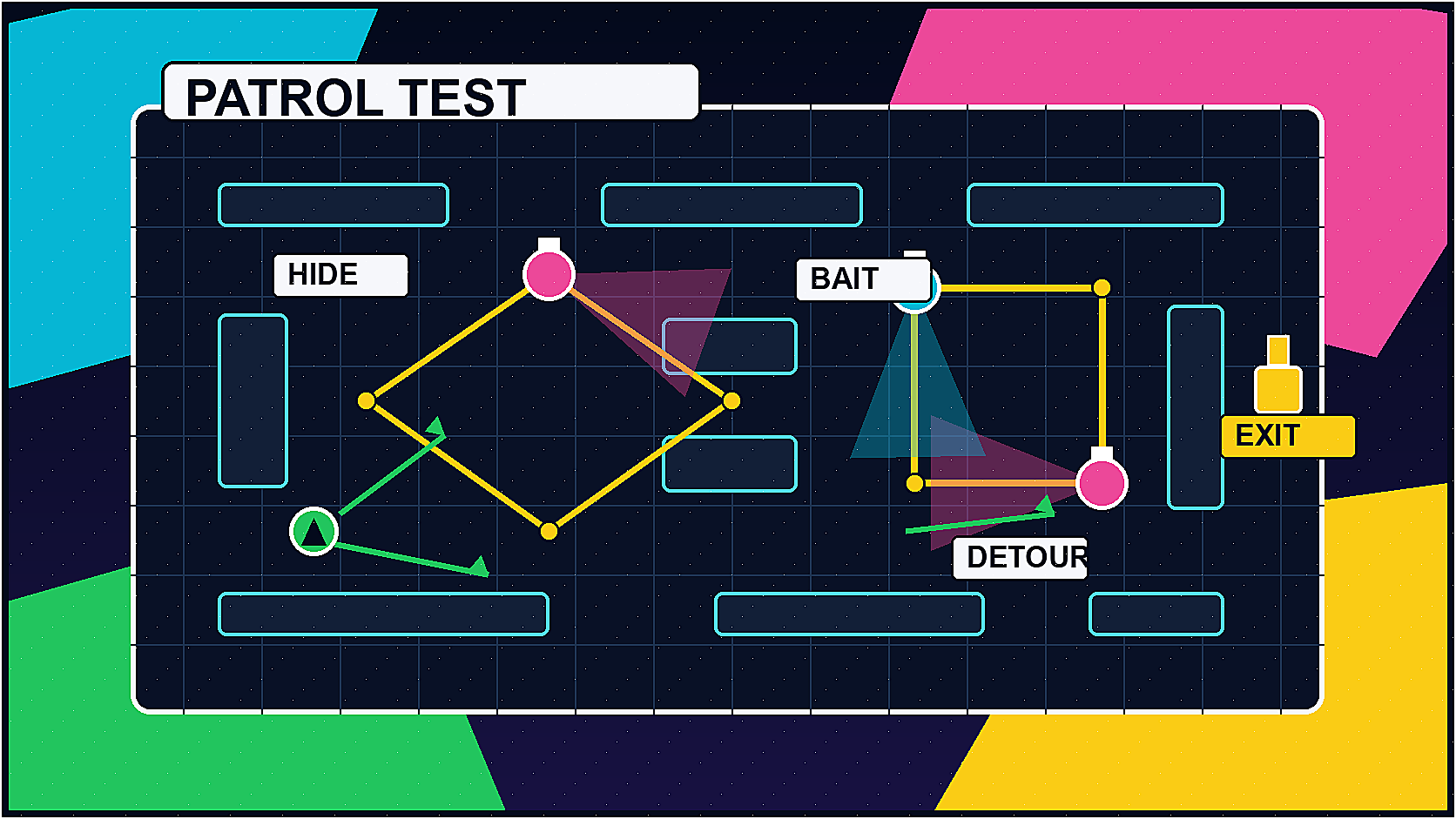
To vibe code enemy patrol routes in a 2D game prototype, prompt one guard, one visible route, one sight cone, one safe pocket, and one reset rule. Do not start with smart pathfinding. Start with a patrol that asks the player a readable question.
The fastest way to ruin a tiny stealth or chase prototype is to ask for an enemy that "hunts the player intelligently." You will get motion. You might even get pressure. What you probably will not get is a choice the player can understand before the collision happens.
A first patrol route should be almost embarrassingly staged. The guard walks a loop. The player sees the loop. The room offers one bad shortcut, one safe wait, and one risky timing window. That is enough. If that does not play, a smarter enemy will only fail with more confidence.
This is a first-playable workflow piece for 2D browser prototypes and small-engine drafts. Phaser is cited for path-following objects, Godot for NavigationAgent2D context, GDevelop for grid-based pathfinding behavior, and Chatforce for a fast prompt-to-playable game studio workflow.
Chatforce
A prompt-to-game studio for making a quick 2D browser-playable patrol room when you want to test the first route before opening an engine project.
Godot
A general engine where NavigationAgent2D, ray checks, timers, and state machines can turn a proven patrol idea into a tuned enemy.
GDevelop
A no-code and low-code builder with pathfinding behavior, obstacles, timers, and variables for fast guard route tests.
Phaser
A JavaScript framework where PathFollower, arcade collision, and custom sight checks can make patrol routes playable in the browser.
A Patrol Is a Question, Not a Roomba
Bad patrols wander. Better patrols ask. Can you cross after the guard turns? Can you bait the guard away from the door? Can you wait in the alcove without getting greedy? Can you take the long route and arrive alive?
That is why the route matters more than the brain. A dumb guard on a readable loop can create tension. A clever guard with no readable pattern just feels like the game decided to find you.
If the player cannot predict the patrol for three seconds, they cannot make a plan. They can only hope.
Weak Prompt vs Patrol Prompt
| Prompt shape | Likely result | Sharper version |
|---|---|---|
| Add enemy AI that chases the player | A guard that moves toward the player without teaching a route | Add one guard that walks four visible patrol points, pauses for 0.5 seconds at each turn, and only chases when the player enters a visible cone |
| Make the level stealthy | A dark room where failure feels arbitrary | Build one lit corridor, one hiding pocket, one shortcut, and one exit behind the guard path |
| Make the enemy smarter | Pathfinding that hides the timing lesson | Keep the enemy dumb until the player can read the patrol, then add a short chase and a clean reset |
| Add more guards | Overlapping cones that blur the mistake | Add a second guard only after the first patrol has one readable hide, bait, or sprint decision |
Prompt the Sight Cone Before the Chase
The cone is the contract. If the player sees the danger shape, they can test it. If the guard just notices them because some invisible radius says so, the prototype becomes an argument.
This is where Chatforce as a game studio fits the first pass. Ask for one browser-playable patrol room with visible cones, a restart key, and a short chase reset. Then play it immediately. Godot, GDevelop, and Phaser give you better knobs later, but the early truth is simple: did the route make you move differently?
Turn pause
Make the guard pause briefly at corners so the player can read direction changes.
If the guard pivots instantly, the player learns to distrust the animation.
Safe pocket
Place one alcove or shadow spot where the player can wait and watch the route.
If hiding is always safe, the room becomes waiting. Put the exit on a timer or a route choice.
Bait point
Let noise, a thrown object, or a visible pickup pull the guard off the main route for a few seconds.
If bait has no downside, it replaces movement instead of supporting it.
Chase reset
When spotted, let the guard chase briefly, then return to patrol if the player breaks line of sight.
If chase never resets, one mistake deletes the rest of the test.
Pathfinding Comes After the Room Works
Pathfinding is useful when the route has already earned complexity. Before that, it can hide the actual design problem. The enemy reaches the player, sure. But did the player understand why they were caught?
For the first playable, use hard patrol points. Draw the line if you can. Show the cone. Put the exit in view. Give the player a reason to move while the guard is moving, not after the guard leaves the screen.
- The guard route is visible or learnable within the first few seconds.
- The sight cone matches the actual detection area.
- The player has one safe place to wait and watch.
- The room includes one tempting shortcut with real risk.
- Being spotted starts a short chase instead of instant failure.
- Breaking line of sight or reaching a safe zone resets the guard cleanly.
- A tester can explain the mistake that got them caught.
Route length
The player understands the guard but has too little or too much waiting time.
Balancing tension against boredom.Turn pause
Players get caught at corners without reading the pivot.
Making direction changes fair.Cone width
The patrol reads well but detection feels too strict or too soft.
Tuning risk without changing the room.Reset distance
The chase either ends too easily or never cools down.
Turning failure into a recoverable scramble.FAQ
How do I vibe code enemy patrol routes in a 2D game prototype?
Prompt one guard with visible patrol points, a sight cone, a safe pocket, a risky shortcut, and a short chase reset. Test whether the player can predict the route before adding smarter pathfinding.
Should I use pathfinding for the first enemy patrol?
Usually no. Use fixed patrol points first so the route teaches timing. Add pathfinding after the room already works and you need the enemy to navigate around real obstacles.
What makes a patrol route feel fair?
The player should see the danger shape, understand the guard turn, and know why they were caught. Fair patrols punish a readable mistake, not invisible detection math.