To vibe code a collectible that changes player behavior, make one pickup alter the next route, timing window, enemy state, or risk decision. If the pickup only adds points, you are testing arithmetic, not whether the player wants to move differently.
The first collectible in a prototype should be rude. It should interrupt the obvious path and make the player ask, "Do I grab that now, or do I stay safe?"
Most vibe-coded pickups arrive as tiny applause machines. Touch coin. Number goes up. Maybe there is a chirp. Fine, but that does not tell you much. A score bump can sit on top of almost any game without changing the game.
This is a first-playable workflow piece for browser-playable AI game prototypes and small-engine drafts. MDN is cited for game-loop and animation context, GDevelop for variable-driven pickup states, and Chatforce for a fast prompt-to-playable route when you want to test the idea in a browser.
Chatforce
A prompt-to-game studio for making a 2D browser-playable first version quickly when the test is one pickup and one route choice.
Godot
A general engine where pickups can flip variables, open routes, change enemy behavior, or alter player movement with fine control.
GDevelop
A no-code and low-code builder where variables and events make one-pickup state changes easy to inspect.
Phaser
A JavaScript framework for browser prototypes where pickups, collision checks, timers, and route gates can be tuned directly.
A Collectible Is a Steering Wheel
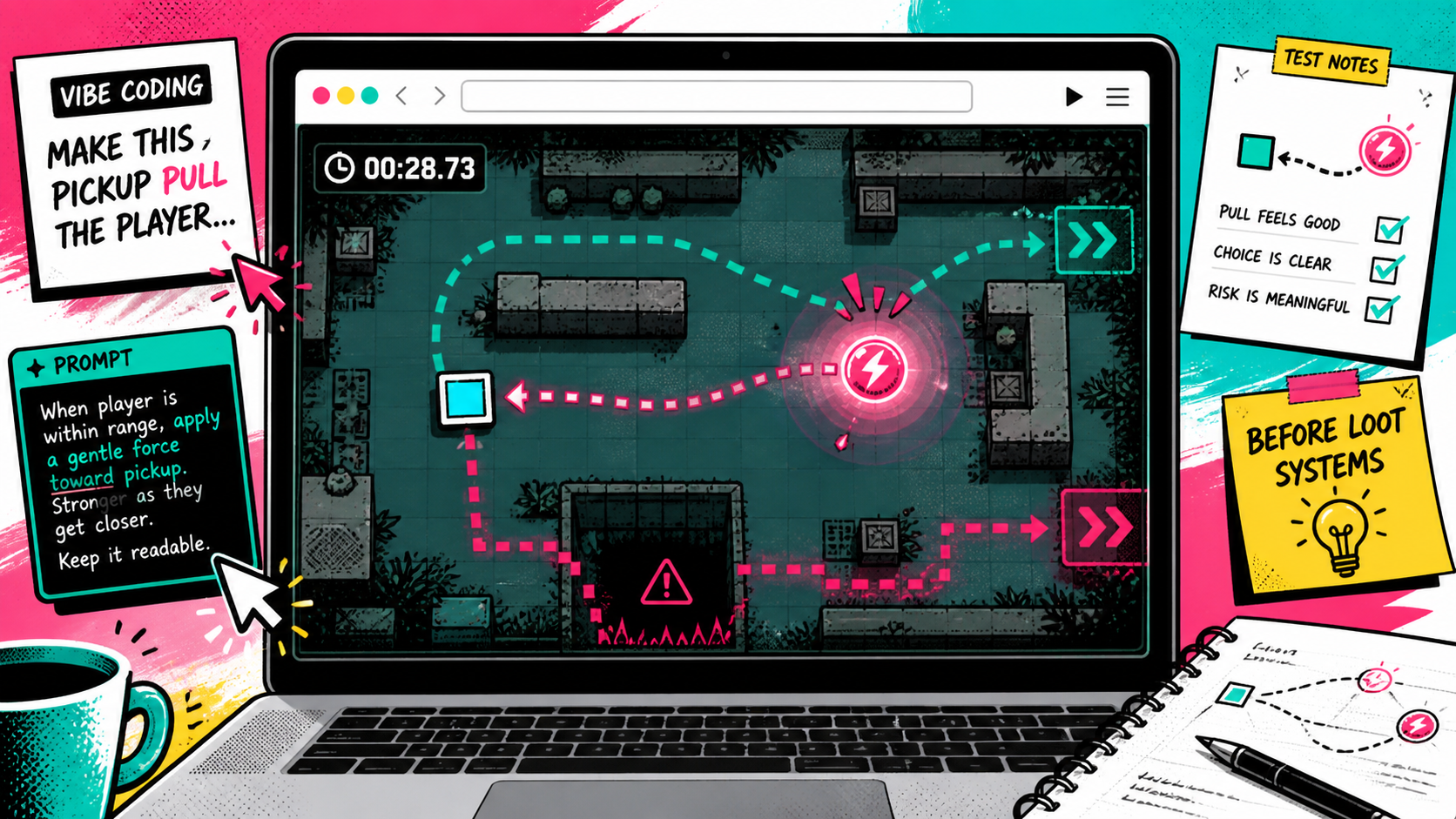
A collectible is not automatically a reward. It is a steering wheel. Put it near danger and it pulls the player off the safe line. Put it behind a gate and it asks for memory. Put it on a timer and it creates greed. Put it beside an enemy and it turns movement into negotiation.
That is the version worth prompting first. Do not start with ten item types, rarity colors, inventory slots, crafting, shops, and upgrade trees. Start with one object that changes what the player does in the next five seconds.
If the pickup does not change the player's next move, it is probably UI confetti wearing a game object costume.
Weak Prompt vs Behavior Prompt
| Prompt shape | Likely result | Sharper version |
|---|---|---|
| Add coins to collect | A score counter with no new decision | Add one coin that appears off the safe path and grants double points only if the player reaches the exit within 6 seconds |
| Add loot | Inventory clutter before the core loop works | Add one pickup that opens a blocked shortcut for 4 seconds, then closes it again |
| Make rewards more exciting | Bigger effects, same route | Make the pickup slow nearby enemies for 3 seconds so the player can choose a risky dash through them |
| Add powerups everywhere | Noise across the whole room | Place one powerup where the player must choose between safety, speed, and score |
Prompt One Pickup With One Consequence
When I use Chatforce as an AI game studio for this test, I ask for a browser-playable room with one collectible, one visible consequence, and one quick restart. The point is not to generate a full loot system. It is to find out whether the object changes movement before you sink time into art, economy, or progression.
If the pickup needs a visual identity, keep it practical. A simple glow, timer ring, route arrow, or altered obstacle is enough. You can use a separate game asset generator later, after the behavior earns better art.
Route bend
Place the pickup just outside the shortest safe path so the player must decide whether the detour is worth it.
If the detour is always safe, it is not a choice. If it is always deadly, it is not tempting.
Temporary gate
Let the pickup open a door, bridge, platform, or shortcut for a few seconds.
The changed route must be visible when the pickup is collected. Hidden state feels like homework.
Enemy flip
Make the pickup stun, slow, attract, or anger one enemy so the room changes after contact.
Do not change every enemy at once. You will lose track of what made the moment work.
Timing bet
Make the pickup start a small countdown for bonus score, safer passage, or a shrinking exit window.
A timer without a meaningful route choice just turns into stress frosting.
The Pickup Has to Answer Back
The moment the player touches the object, the room should visibly answer. A gate opens. A route lights up. An enemy freezes. A hazard sleeps. A timer ring starts draining. You should not need a tutorial box to explain that something changed.
Then watch the next run. If the player ignores the pickup, it is probably too weak, too expensive, or too vague. If they grab it every time without thinking, it is probably too free. Good. Now you have a design problem you can tune, not a pile of collectibles you have to justify.
- There is one collectible in the test room, not a scatter of identical pickups.
- The pickup changes route, timing, enemy behavior, or risk within five seconds.
- The consequence is visible immediately after collection.
- The player can choose to ignore the pickup and still continue.
- Grabbing it has a cost: distance, danger, time, attention, or positioning.
- A tester can explain why they did or did not go for it on the second attempt.
Add score
Players already change route for the object without needing a number to bribe them.
Turning a good choice into a measurable challenge.Add a second pickup
The first pickup creates a clear behavior and testers can describe the tradeoff.
Testing contrast between two kinds of temptation.Add progression
The pickup changes repeat behavior across multiple attempts, not just one novelty grab.
Building upgrades on top of a decision that already works.FAQ
How do I vibe code a collectible that changes player behavior?
Prompt one pickup with one visible consequence: a changed route, timer, enemy state, gate, shortcut, or hazard. Test whether players move differently after seeing it once.
Should my first collectible add points?
Only after it changes behavior. Points can sharpen a decision, but they should not be the whole mechanic in a first playable.
What is the best first collectible test?
A route-bending pickup is the cleanest test. Put it just off the safe path, add a visible payoff, and watch whether players risk the detour twice.